Retirement planning
Self Direct Your 401K & IRAs – Take Control Of Your Assets
Schedule a ConsultationSelf Direct Your 401K & IRAs – Take Control Of Your Assets
Do you want to take control of your retirement fund? Then a Self Directed IRA or Self Directed 401K plan is what you need. We can advise clients on how investments such as real estate or private loan will help increase their retirement wealth.
We tailor solutions for clients that provide:
- More Control of IRA/401K Assets
- Opportunities For Real Estate Investments Using IRA/401K Funds
- Development of Limited Liability Companies (LLC’s) To Gain Checkbook Control
- Benefit Plan Factoring To Quickly Build 401K Assets
It’s time to truly make your IRA/401K plan SELF-DIRECTED.
401k — KA Lindow — Watch on YouTube
More Information
- 401K Options
- Investor Control
- Benefit Plan Factoring
- Rollovers as Business Startups (ROBS)
- Self Directed Real Estate Investing
- IRA & 401K Order Form
Q: Why Self-Directed 401K?
A: According to the 2002 National Summit on Retirement Savings, retirees will need between 74% – 84% of their pre-retirement income to maintain their standard of living.
- Schwab estimates workers will need $300,000 for every $1000 in monthly retirement income.
- At the end of 2005 there were 4.7 trillion in IRA assets and less than 2% invested in Real Estate.
Q: What is a Self Directed IRA SDIRA?
A: Self-directed IRA is a type of Roth IRA, or a traditional IRA, which means you are allowed to save for your retirement or your retirement account with tax advantages with the same IRA contribution limits. What differentiates Self-directed IRAs from others is solely the types of alternative investments, or alternative assets you own in the account, for instance, your retirement accounts.
Q: How Does Self-Directed IRA Differ from Regular IRAs?
A: Regular IRAs usually bear only mutual funds, stocks, bonds, and common investments. On the other hand, self directed IRAs are more versatile. For instance, you can invest your other retirement accounts in real estate assets or a private equity. However, self directed IRA custodians are needed to the arrangements of self directed retirement accounts. Self-directed account owners can have a better financial future by securing tax-free income this way.
Q: Why haven’t I heard about flexible IRA/401K investing before?
A: Brokerage companies earn commissions when you buy and sell stocks, bonds, and mutual funds. They don’t make money when you buy real estate. Further, very few custodians are interested in holding “non-traditional” assets they don’t understand. Finally, the industry is small. Only a few firms such as ours provide “full service” to self-directed retirement plan beneficiaries.
Q: Can I really invest my retirement assets in real estate?
A: Absolutely! In 1974, the Employee Retirement Income Security Act (ERISA) gave all self-directed retirement plans this option. In addition to real estate, you can direct your IRA/401K investments into, among other things, mortgages, notes, tax liens, and private businesses. There are, of course, restrictions on some investments, but we will help you navigate around them. If you need self-directed IRAs we are the ones you need.
Q: What are IRA transfers and IRA/401K rollovers?
A: A “rollover” occurs when an individual requests a distribution from an IRA/QRP (Qualified Retirement Plan) and then “rolls” the assets into another IRA/401K. An individual is limited to one rollover per year. A “transfer” is when IRA/401K assets are moved directly from one financial institution to another without the IRA/401K owner taking possession of the assets. Unlike rollovers, there is no limit on how many transfers can be executed in a year.
Q: How can I leverage the assets in my IRA/401K to buy more expensive properties?
A: You can use the equity in the property that you expect to purchase to borrow funds on a non-recourse basis, and you can also pool your IRA/401K funds with those of other people, other IRAs, or even your personal funds to buy large properties. The leverage limitation is not placed on 401K funds.
Q: Are there any investments that I can’t make with my self-directed IRA/401K?
A: You cannot invest in Life Insurance Contracts or Collectibles (as defined by the IRS rules). Also, you may not participate in prohibited transactions.
Q: What exactly is a “prohibited transaction?”
A: IRA/401K transactions must be for the exclusive benefit of the retirement plan and must not directly or indirectly benefit the IRA/401K owner. For example, the owner cannot:
- Borrow money from his IRA, but you may borrow from your 401K
- Buy property for personal use with his IRA or 401K funds
- Use IRA or 401K assets to secure a personal loan
- Sell property to your IRA or 401K
Q: How fast can I respond to an investment opportunity?
A: You can respond immediately to any allowed investment opportunity, because you’re in control of your funds. The only delay would be to you, make sure that the transaction is structured within the confines of the tax law. This information is only a phone call away to our office.
Q: When an investment is sold by my IRA or 401K, can I keep the profit that is above my initial investment?
A: All money generated from an investment owned in an IRA or 401K must be deposited back into the respective account. Of course there is no income tax on this profit until you begin taking annual distributions from their plan.
Q: Are there any pitfalls to self-directed IRA or 401K plans?
A: There are many potential pitfalls with respect to both prohibited transactions and timely reporting at the state and federal levels. We specialize in structuring transactions in “safe harbors” to avoid such problems and ensure statutory compliance.
Q: Who makes the IRA’s or 401K investment decisions?
A: You do. Your account is truly “self-directed,” which means that you make the investment decisions for your retirement assets in much the same way as you invest outside of your retirement plan. But you don’t invest alone. We will help you navigate the complex rules that govern prohibited transactions so you can focus on making the best investment decisions.
Q: How are my assets managed?
A: Your assets are managed by you. You make all investment decisions, and we take care of all of the paperwork and reporting details. Once you make an investment, you may track the investment results or, we will keep your books and records if you desire. We help with the annual asset valuation, and file all required annual reports.
Q: What are the benefits of having a Limited Liability Company (LLC) own my IRA/401K assets?
A: There are many advantages of using an LLC to own your IRA’s or 401K assets. The LLC structure offers maximum investment flexibility, provides asset protection, allows for “checkbook control”, simplifies asset titling, eases pooling of assets, and allows for immediate response to investment opportunities.
Q: Can I combine personal money with my IRA/401K money to make an investment?
A: Yes. You and your IRA or 401K can purchase an investment together. However, since you cannot sell property to your retirement plans, transactions between you and your plan involving an asset after that asset is purchased are prohibited.
Q: How much support can I expect from you?
A: We are proud of our superior customer service. We have several full-time CPAs and attorneys, who are available to answer your technical questions at any time. We also provide quarterly newsletters and educational information for our clients and their other professional advisors.
Q: What is your fee structure?
A: We have an initial fee that covers the setup of your self directed IRA, 401K, LLC and all associated transactions and documentation, and we have an all inclusive yearly administrative fee for whatever level of service you desire.
Q: Are there restrictions on where my IRA or 401K can purchase real estate?
A: No. You can purchase real estate anywhere.
Please contact me if you have any questions. If you haven’t set up your true Self Directed IRA/401K, you should do it now. This will really put your retirement funds under your control and reduce your maintenance fees. There are rules on precious metals, unrelated business income tax because you will need sound investment advice to ensure your tax-advantaged account which we can help with. If you need a self-directed IRA custodian to help you with self-directed IRA rules, IRA funds, and your individual retirement account, you can call us.
Self-Direct Your Retirement Funds
Did you know that you could take charge of your own retirement funds and invest them in virtually anything that you believe can make you money, and where they are secure from stock market fluctuations?
Yes, the tax law permits you to convert your retirement funds into self-directed IRAs or 401(k) plan where you control them.
Many individuals have purchased real estate and other assets as alternative investments for their retirement plans. If you invest with IRA funds, you still need an outside custodian that will permit you to invest in alternative investments. Whereas, if you set up a self-directed 401(k) plan, you will not need to pay outside parties an annual fee.
Checkbook Control Means Flexibility
The conversion of retirement funds can be done at any time and will permit you to have checkbook control over your retirement assets. This flexibility allows you to seek out alternative investments that can increase in value either tax-deferred or tax-free until you retire.
Yes, You Can Invest In Real Estate
The self-directed plan permits you to acquire investments i.e. real estate with debt financing either with a bank loan or with private financing on the property. This allows you to increase your retirement investment assets in a way that cannot be done with most conventional retirement accounts.
No Limit To The Amount Of Money You Put In
There is no limit on the amount of retirement assets that you can convert into a self-directed account. The IRS and the Department of Labor both have various stringent rules that must be followed so as not to cause taxation of retirement assets.
Generally, professional help should be sought to make sure that no tax laws are broken. If you have retirement funds that you want to diversify and control yourself while earning tax-free or tax deferred income until retirement, then establishment of a Self-directed IRA or 401K plan is an option to consider.
Ken Lindow, CPA
Ken Lindow, CPA and a former top Inc.500 CFO specializes in tax structuring of real estate investments, ROBS 401k plans for business investing and 401(k) self-directed tax plans for investment planning, as will and business strategy planning for new ventures and fast business growth.
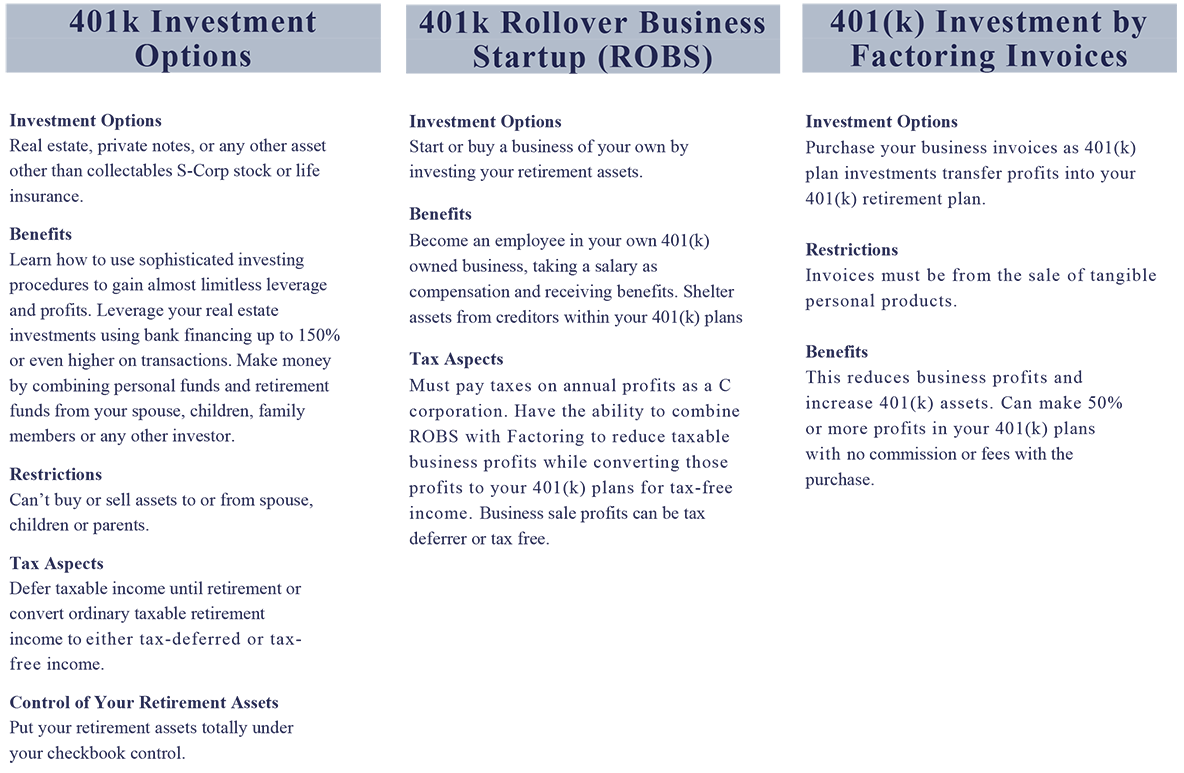
Self Directed 401k Options
Investment Options
Real estate, private notes, or any other asset other than collectables S-Corp stock or life insurance.
Benefits
Learn how to use sophisticated investing procedures to gain almost limitless leverage and profits. Leverage your real estate investments using bank financing up to 150% or even higher on transactions. Make money by combining personal funds and retirement funds from your spouse, children, family members or any other investor.
Restrictions
Can’t buy or sell assets to or from spouse, children or parents.
Tax Aspects
Defer taxable income until retirement or convert ordinary taxable retirement income to either tax-deferred or taxfree income.
Control of Your Retirement Assets
Put your retirement assets totally under your checkbook control.
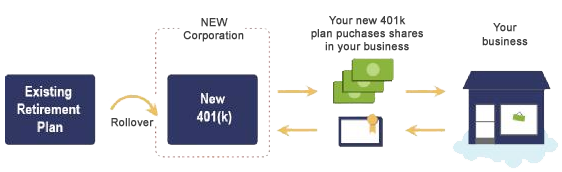
401k Rollover Business Startup (ROBS)

Investment Options
Start or buy a business of your own by investing your retirement assets.
Benefits
Become an employee in your own 401(k) owned business, taking a salary as compensation and receiving benefits. Shelter assets from creditors within your 401(k) plans.
Tax Aspects
Must pay taxes on annual profits as a C corporation. Have the ability to combine ROBS with Factoring to reduce taxable business profits while converting those profits to your 401(k) plans for tax-free income. Business sale profits can be tax deferrer or tax free.
ROBS Tax Aspects
401K Investment by Factoring Invoices
Investment Options
Purchase your business invoices as 401(k) plan investments transfer profits into your 401(k) retirement plan.
Restrictions
Invoices must be from the sale of tangible personal products.
Benefits
This reduces business profits and increase 401(k) assets. Can make 50% or more profits in your 401(k) plans with no commission or fees with the purchase.
Self-Directed 401K or IRA Investor Control |
||||
| Personal Funds Available for Investing | Regular IRA or 401K Funds Available for Investing | Roth IRA or 401K Funds Available for Investing | ||
| Personal Assets | IRA or 401K AssetsOwned: 100% by IRA or 401K Client | Roth IRA or 401K AssetsOwned: 100% by Roth IRA or 401K Client | ||
 |
|
|
||
| Personal Investments, LLC | IRA or 401K Investing, LLC | Roth IRA or 401K Investing, LLC | ||
|
Arizona LLC Owned: 100% by Investor |
Arizona LLC Owned: 100% by IRA or 401K Managed by IRA or 401K Owner |
Arizona LLC Owned: 100% by Roth IRA or 401K Managed by IRA or 401K Owner |
||
|
|
|
|
||
| Combined Investment (Possible) | ||||
| Profit Sharing between Members | ||||


What Is Benefit Plan Factoring?
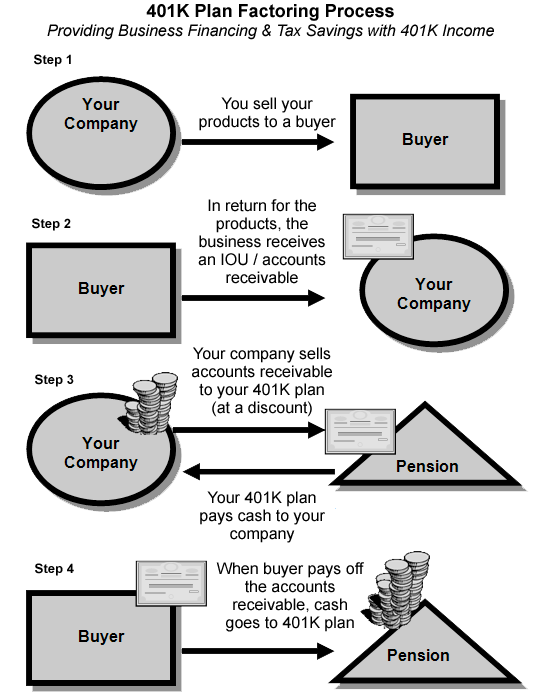
Benefit plan factoring is similiar to business factoring and invoice factoring – it’s selling your business accounts receivable, but to your 401K Plan for immediate cash. It reduces business income tax and builds your 401K Plan.
With a Self Directed 401K, you can now turn that tax free money to build your wealth, invest in real estate or private loans, or other sophisticated investing.
How It Works
Purchase your business invoices as 401K plan investments and transfer profits into your 401K plan. This reduces business profits and increases 401K assets. It can make 50% or more profits in your 401K plans with no commission or fees with the purchase.
Ready To Get Started?
If you are ready to get started with factoring, download the order form below and email or fax it back. It’s that easy!
Benefit Plan Factoring Order Form
Frequently Asked Questions
These frequently asked questions and answers are provided for general information only and should not be cited as any type of legal authority. They are designed to provide the user with information required to respond to general inquiries. Due to the uniqueness and complexities of Federal tax law, it is imperative to ensure a full understanding of the specific question presented, and to perform the requisite research to ensure a correct response is provided.
Q: Are there special limits on the type of investments available to retirement plans?
A: Although there is no list of approved investments for retirement plans, there are special rules contained in the Employee Retirement Income Security Act of 1974 (ERISA) that apply to retirement plan investments. In general, a plan sponsor or plan administrator of a qualified plan who acts in a fiduciary capacity is required, in investing plan assets, to exercise the judgment that a prudent investor would use in investing for his or her own retirement. (ERISA § 404)
In addition, certain rules apply to specific plan types. For example, there are different limits on the amount of employer stock and employer real property that a qualified plan can hold, depending on whether the plan is a defined benefit plan, a 401(k) plan, or another kind of qualified plan. (ERISA §407) Certain plans, such as 401(k) plans, that permit participant-directed investment can avoid some fiduciary responsibilities if participants are offered at least three diversified options for investment, each with different risk/return factors. (Labor Reg. §2550.404c-1)
Both participant-directed accounts and IRAs cannot invest in collectibles, such as art, antiques, gems, coins, or alcoholic beverages, and they can invest in certain precious metals only if they meet specific requirements. (Code §408(m))
Individual retirement accounts also are not permitted to invest in life insurance. (Code §408(a)(3))
Finally, certain transactions between a plan and a “disqualified person” are specifically prohibited by law; see Q&A-2. Similar rules apply to transactions between an IRA and its owner or beneficiary or between an IRA and a “disqualified person;” see Q&A-6.
Q: What is a prohibited transaction?
A: A prohibited transaction is a transaction between a plan and a disqualified person that is prohibited by law.
Prohibited transactions generally include the following transactions:
- a transfer of plan income or assets to, or use of them by or for the benefit of, a disqualified person;
- any act of a fiduciary by which plan income or assets are used for his or her own interest;
- the receipt of consideration by a fiduciary for his or her own account from any party dealing with the plan in a transaction that involves plan income or assets;
- the sale, exchange, or lease of property between a plan and a disqualified person;
- lending money or extending credit between a plan and a disqualified person; and
- furnishing goods, services, or facilities between a plan and a disqualified person.
Certain transactions are exempt from being treated as prohibited transactions. For example, a prohibited transaction does not take place if a disqualified person receives a benefit to which he or she is entitled as a plan participant or beneficiary. However, the benefit must be figured and paid under the same terms as for all other participants and beneficiaries.
The Department of Labor (DOL) has granted class exemptions for certain types of investments under conditions that protect the safety and security of the plan assets. In addition, a plan sponsor may apply to the DOL to obtain an administrative exemption for a particular proposed transaction that would otherwise be a prohibited transaction.
For additional information, see Publication 560, Retirement Plans for Small Business (SEP, SIMPLE, and Qualified Plans).
Q: What is a disqualified person for purposes of the prohibited transaction rules?
A: A disqualified person is any of the following:
- a fiduciary of the plan;
- a person providing services to the plan;
- an employer, any of whose employees are covered by the plan;
- an employee organization, any of whose members are covered by the plan;
-
any direct or indirect owner of 50% or more of any of the following:
- the combined voting power of all classes of stock entitled to vote, or the total value of shares of all classes of stock of a corporation that is an employer or employee organization described in (3) or (4);
- the capital interest or profits interest of a partnership that is an employer or employee organization described in (3) or (4); or
- the beneficial interest of a trust or unincorporated enterprise that is an employer or an employee organization described in (3) or (4);
- a member of the family of any individual described in (1), (2), (3), or (4) (i.e., the individual’s spouse, ancestor, lineal descendant, or any spouse of a lineal descendant);
-
a corporation, partnership, trust, or estate of which (or in which) any direct or indirect owner described in (1) through (5) holds 50% or more of any of the following:
- the combined voting power of all classes of stock entitled to vote or the total value of shares of all classes of stock of a corporation;
- the capital interest or profits interest of a partnership; or
- the beneficial interest of a trust or estate;
- an officer, director (or an individual having powers or responsibilities similar to those of officers or directors), a 10% or more shareholder, or highly compensated employee (earning 10% or more of the yearly wages of an employer) of a person described in (3), (4), (5), or (7);
- a 10% or more (in capital or profits) partner or joint venture of a or (7); or person described in (3), (4), (5), or (7); or
- any disqualified person, as described in (1) through (9) above, who is a disqualified person with respect to any plan to which a multiemployer plan trust is permitted to make payments under section 4223 of ERISA.
For additional information, see Publication 560, Retirement Plans for Small Business (SEP, SIMPLE, and Qualified Plans).
Q: What are the consequences of participating in a prohibited transaction?
A: A disqualified person who takes part in a prohibited transaction must correct the transaction and must pay an excise tax based on the amount involved in the transaction.
The initial tax on a prohibited transaction is 15% of the amount involved for each year (or part of a year) in the taxable period. If the transaction is not corrected within the taxable period, an additional tax of 100% of the amount involved is imposed. Both taxes are payable by any disqualified person who participated in the transaction (other than a fiduciary acting only as such). If more than one person takes part in the transaction, each person can be jointly and severally liable for the entire tax.
The amount involved in a prohibited transaction is the greater of the following amounts:
- the money and fair market value of any property given; and
- the money and fair market value of any property received.
If services are performed, the amount involved is any excess compensation given or received. The taxable period starts on the transaction date and ends on the earliest of the following days:
- the day the IRS mails a notice of deficiency for the tax;
- the day the IRS assesses the tax; and
- the day the correction of the transaction is completed.
The tax is paid with Form 5330.
For additional information, see Publication 560, Retirement Plans for Small Business (SEP, SIMPLE, and Qualified Plans).
Q: How is a prohibited transaction corrected?
A: A disqualified person who participated in a prohibited transaction can avoid the 100% tax by correcting the transaction as soon as possible. Correcting the transaction means undoing it as much as possible without putting the plan in a worse financial position than if the disqualified person had acted under the highest fiduciary standards.
If the prohibited transaction is not corrected during the taxable period, the disqualified person usually has an additional 90 days after the day the IRS mails a notice of deficiency for the 100% tax to correct the transaction. This correction period (the taxable period plus the 90 days) can be extended if either of the following occurs:
- the IRS grants reasonable time needed to correct the transaction; or
- the disqualified person petitions the Tax Court.
If the transaction is corrected within this period, the IRS will abate, credit, or refund the 100% tax.
For additional information, see Publication 560, Retirement Plans for Small Business (SEP, SIMPLE, and Qualified Plans).
Q: How do the prohibited transactions rules apply to IRAs?
A: A prohibited transaction with respect to an IRA occurs if the owner or beneficiary of the IRA engages in any of the transactions described in Q&A-2.
However, in this case, with an individual retirement account, instead of imposing an excise tax on the parties to the transaction, the Code provides that the account is no longer an individual retirement account, and it is treated as if the assets were distributed on the first day of the taxable year in which the prohibited transaction occurred. (Code §408(e)(2))
A prohibited transaction can also occur between an IRA and a disqualified person other than the IRA owner or beneficiary, such as a relative of the owner or beneficiary or a fiduciary. If a prohibited transaction with respect to an IRA involves a disqualified person other than the IRA owner or beneficiary, then that other person is subject to the prohibited transactions excise tax.
For additional information, see Publication 590, Individual Retirement Arrangements (IRAs).
Q: What does it cost to factor receivables?
A: A factoring fee can range from as low as 1% to 6%. The bottom line is if you can increase your business, take early payment discounts from your vendors, and not borrow a single penny from a bank, then it will cost you nothing. Our clients have grown their businesses and increased their bottom line by factoring. It will cost you more money if you are missing out business opportunities by not having adequate working capital. The question you should ask is not what factoring will cost, but will factoring benefit my business by having cash today and not wait 30-60 or even 90 days? Will my business increase the bottom line by having a better cash flow turn on my receivables.
Q: How are fees and advance rates determined?
A: It is based on several factors:
- The credit worthiness of your clients
- Your monthly billing volume
- Average invoice size
- Average days to payment
- Fees can range from 2-5 % of the invoice’s face value.
- For example if the invoice’s value is $1,000; a fee of 3% equals $30
Convert Business Accounts Receivable into Personal 401(k) Tax Free Income
Did you know there is a way to convert your business Accounts Receivable received from selling tangible personal products into your 401(k) as an investment while reducing your business taxes and receiving tax-free income all at the same time? This is a little-known tax strategy that is permitted by the pension rules but not promoted by banks, insurance companies, or investment firms. (Why don’t banks, insurance companies or investment firms promote this? Because there is no product for them to sell and earn commission from.)
Who Can Set Up Invoice Factoring?
- Anyone that has a business and sells tangible products to customers on credit can set up an Internal Invoice Factoring program for their personal benefit.
- The person/business needs to have a personal self-directed 401(k) plan or pension plan established and then needs to undertake the setup of this Accounts Receivable sale process.
- Anyone can undertake this process at any point during the year.
- Once the process has been established for the business and the business can begin selling receivables into their own 401(k) pension plan as an investment.
What Are The Benefits?
The main benefits from establishing this plan are:
- They provided a much better investment return for your pension plan (generally greater than 30% per year investment rate of return)
- The investment in your pension plan is one that you are extremely familiar with i.e. customer accounts receivables and you have complete operational control over them
- The new plan does not affect your ability to make your annual contributions to the 401(k) plan
- The process permits fast build-up of assets for you and your spouse
- It can be structured so that income can accumulate tax-free for distribution upon retirement
- Because these assets are within your 401(k) pension, plan, they are shielded from creditor claims
Fast 401(K) Asset Accumulation That Will Either Be Tax Deferred Or Even Tax-Free Income
The program can be structured so the income that is accumulated will be tax-deferred – or it may even be structured to be tax-free upon retirement.
You have the ability to achieve an extremely fast build-up of assets and income in your 401(k)-retirement plan as well as reducing your business taxable income while converting that business income into tax-free retirement income.
This is the best of both worlds, reducing business taxes, increasing retirement income, and saving taxes on retirement distributions all at the same time from doing virtually the same thing that you’re doing right now, collecting customer accounts receivable.
Internal Invoice Factoring Investment Plan
This plan requires that the 401(k) be established for a period of five years prior to taking out withdrawals from the pension plan at 59 ½ years of age for tax-free treatment. These plans have specific rules and requirements specified by the Department of Labor for both establishment and set up and its operations, therefore it is important to have someone knowledgeable about them for guidance, help, establishment, and operations of the plan.
Contact us for further information on this tax saving process and for our FREE – Pre-Qualifying Checklist to see if would work in your business.
Ken Lindow, CPA
Ken Lindow, CPA and a former top Inc.500 CFO specializes in tax structuring of real estate investments, ROBS 401k plans for business investing and 401(k) self-directed tax plans for investment planning, as will and business strategy planning for new ventures and fast business growth.
Take the next step
Make your next decision with more clarity.
Tell us what you are working toward and where you need guidance.